Preventive Care
How Often Should You Really See the Dentist? (It Depends on You)
Every six months is a good rule of thumb, but the right schedule depends on your gums, your history and your habits. Here is how we decide at Tender Dental Care.
By Dr. Prabha Raju, DDS · August 10, 2026 · 5 min read
Most of us grew up hearing that you should see the dentist twice a year. It is a good starting point, and for a lot of healthy adults it is exactly right. But it is not one size fits all, and treating it as a law of nature means some people come in more than they need to while others, the ones who would benefit most, are told they are fine when they are not. At our Burton office we set your schedule from what your mouth is actually doing.
Why six months became the default
Six months is a sensible average. It is roughly how long it takes for enough plaque to harden into tartar that brushing cannot shift it, and it is short enough that most problems get caught while they are still small and cheap to fix. What it is not is a number derived from your particular gums, your saliva, your diet or your history. It is a reasonable default in the absence of better information, and the point of an exam is to give us better information.
Who does well with every six months
If your gums are healthy and do not bleed, you rarely get cavities, you do not smoke and you brush twice a day and clean between your teeth most days, a six-month rhythm keeps you in good shape. It is frequent enough to catch small problems early and to remove the tartar that builds up no matter how carefully you brush, and infrequent enough that it never becomes a chore.
Who should come more often
Some people are simply at higher risk, and for them a three or four month interval is not upselling, it is the thing that keeps their teeth. The common reasons:
- Anyone being treated for gum disease, usually every three to four months to keep the bacteria from re-establishing below the gumline
- Patients with diabetes, which makes gum infection both more likely and slower to heal
- Smokers and vapers
- People prone to cavities, including anyone with dry mouth from medication, and dry mouth is a side effect of a surprising number of common prescriptions
- Patients wearing braces or clear aligners, where brackets and attachments make cleaning genuinely harder
- Pregnant patients, because hormonal changes make gums far more reactive
- Anyone with a lot of crowns, bridges or implants to look after
If you are in one of these groups, the extra visits usually cost less than the problems they prevent. That is not a sales line. A periodontal maintenance appointment is a fraction of the cost of treating the bone loss that follows from skipping them.
Who can safely stretch to once a year
It happens, and we will say so. A low-risk adult with excellent home care, no fillings, no gum pockets and no history of decay may genuinely not need to be here every six months. We would still want to see you annually to screen for oral cancer and to check that nothing has changed quietly, but we are not going to invent a reason to book you in.
What actually happens at a check-up
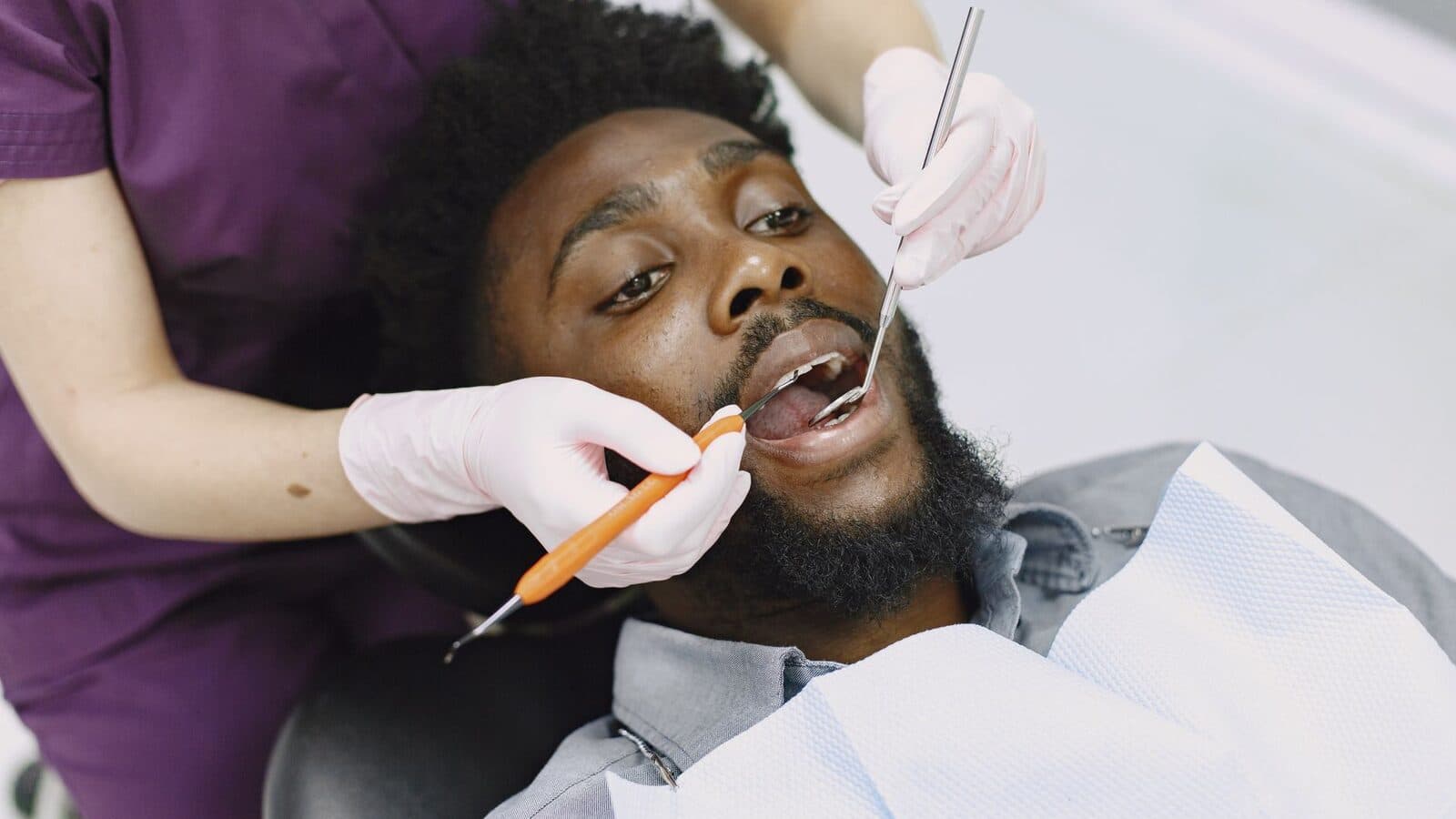
The visit starts with a conversation: how you have been, anything that has bothered you, anything you would like to change about your smile. Then Dr. Raju checks every tooth, measures the gum pockets, screens for oral cancer, and looks at how your jaw and bite work together. Digital X-rays are taken when something warrants them rather than automatically.
The cleaning removes plaque and tartar above and below the gumline, polishes away surface stains and leaves your mouth genuinely clean. Before you go, you get a plain-language account of what we found and what, if anything, to do about it. If the answer is nothing, we say nothing.
How often do you really need X-rays?
This is one of the most common questions we get, and the honest answer is less often than many people expect. X-rays are a diagnostic tool, not a routine, and we take them when the exam, your risk level or a specific symptom calls for them. A low-risk adult with no new problems might go a couple of years between sets. Someone with active decay or gum disease will need them more often. Digital X-rays use a small fraction of the radiation of the film versions most adults remember.
What happens if you wait too long
Dental problems are quiet until they are not. Decay does not hurt until it reaches the nerve, and gum disease does not hurt at all until teeth start to loosen. That is the whole problem with using pain as your appointment reminder: by the time it arrives, the cheap version of the fix has usually passed.
A small cavity that would have been a filling becomes a root canal and a crown. Inflamed gums that would have responded to a cleaning become bone loss, and bone does not grow back on its own. The cost goes up in money, in chair time and in how much of your own tooth you get to keep.
If it has been years, come anyway
We see patients every week who have not had a cleaning in five, ten or twenty years, often because of a bad experience a long time ago or because life simply got in the way. Nobody here is going to lecture you or make you feel small about it. Your first visit takes 60 to 90 minutes and ends with options explained in plain language and the costs in writing. If you are nervous, say so when you book and we will plan the appointment around that, including nitrous oxide or oral sedation if that helps.
What your insurance probably covers
Most PPO plans cover two preventive visits a year, and many will cover more frequent periodontal maintenance when it is medically necessary rather than elective. We accept Medicare and Medicaid along with most PPO plans and the Healthy Michigan Plan, and we file claims for you. Call the front desk with your card and we will check your specific benefits before you come in, so the only thing you have to think about on the day is showing up.
The bottom line
Come in, let us look, and we will tell you honestly how often you need to be here. It might be three months. It might be a year. Call us at (810) 715-3368 or request an appointment online. We are at 1024 N. Genesee Rd in Burton, just off I-69, minutes from Flint, Davison and Grand Blanc, with free parking at the door.
Questions patients ask us
For most healthy adults, yes. If you have gum disease, diabetes, braces or frequent cavities, every three to four months protects you better. We will tell you honestly which schedule fits you.
Most PPO plans cover two preventive visits per year, and many cover more frequent periodontal maintenance when it is medically needed. Our team checks your benefits before you come in.
Less often than most people assume. We take them when something in the exam calls for it rather than on a fixed schedule, which for a low-risk adult can mean every couple of years.
Children are usually seen every six months, partly to catch decay early and partly to watch how the adult teeth are coming in. Sealants and fluoride are easiest to apply at the right moment.
Request a visit online or call (810) 715-3368. Your first appointment is a conversation, an exam and a plan. No lectures.
Have a question about your smile? Ask a Burton dentist who listens.
Tender Dental Care welcomes new patients from Burton, Flint, Grand Blanc, Davison and all of Genesee County. Request a visit online or call and a real person will answer during office hours.
Related services

About the author
Dr. Prabha Raju, DDS
Dr. Raju has practiced dentistry in Burton, Michigan since 1997, with advanced training in implants, sedation, laser dentistry and Invisalign.
Meet Dr. Raju →Tender Dental Care, 1024 N. Genesee Rd, Burton, MI 48509. Serving Flint, Grand Blanc, Davison, Flushing, Swartz Creek, Fenton and Genesee County. This article is general information, not a diagnosis; please see a dentist for advice about your own mouth.