Orthodontics
Invisalign or Braces? An Honest Comparison for Adults and Teens
Clear aligners are not better than braces, and braces are not better than aligners. They are good at different things. Here is how we decide which one fits your case.
By Dr. Prabha Raju, DDS · August 28, 2026 · 4 min read
The question we hear most often from adults in Burton is some version of this: can I do it without anyone noticing? Clear aligners made that possible, and they have become the default request. But aligners are not automatically the better choice. They are better at some things and worse at others, and the honest answer depends on what your teeth are actually doing.
The short version
- Invisalign suits mild to moderate crowding, spacing and relapse after childhood braces, and anyone who cannot have visible brackets at work
- Braces suit complex bite problems, significant rotations, teeth that need to move vertically, and growing teenagers
- Aligners only work while they are in your mouth, so they ask more of you
- Braces work whether you cooperate or not, which for some patients is the real advantage
What Invisalign is genuinely good at
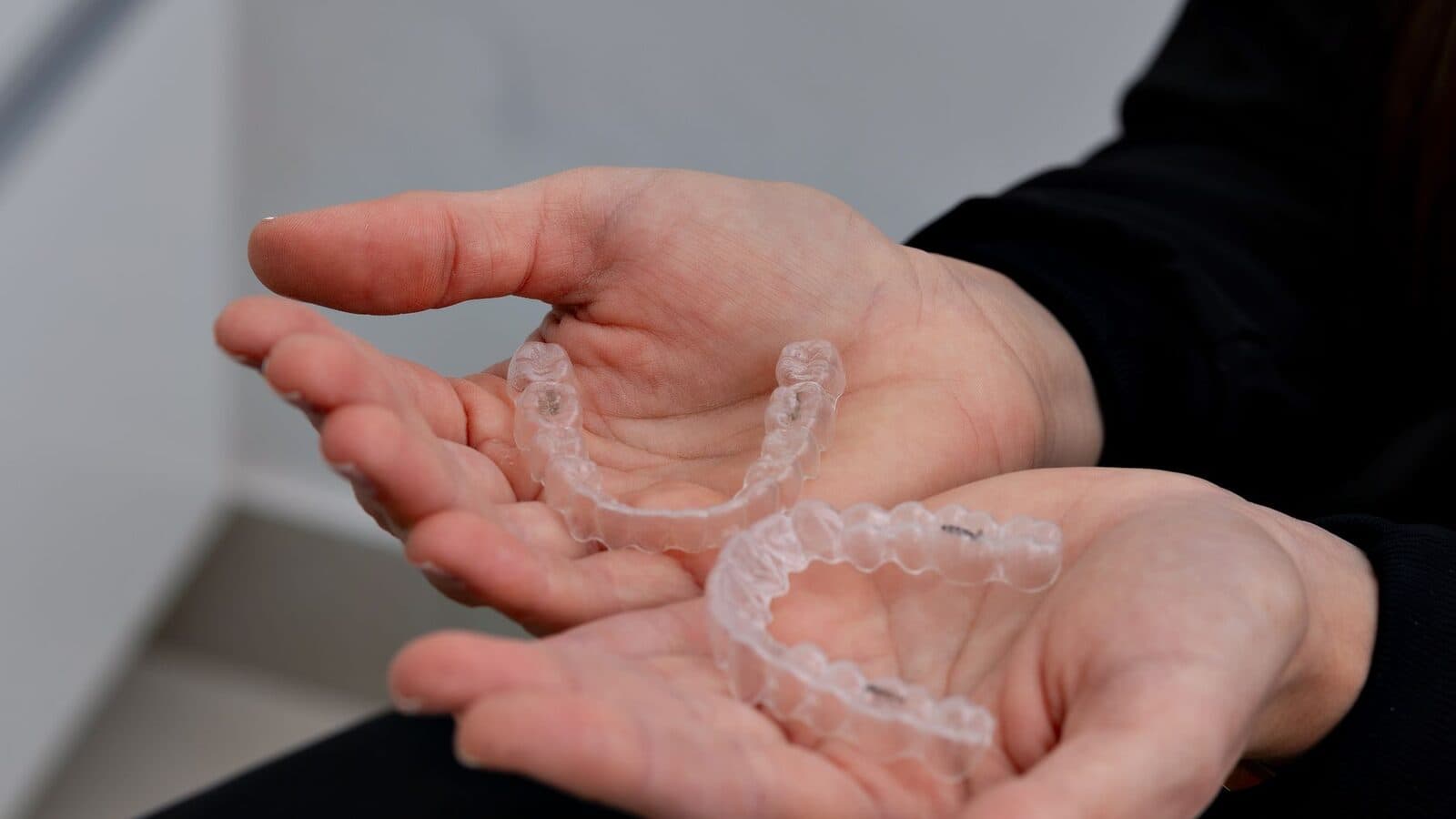
Invisalign moves teeth with a series of clear, removable trays that you change every week or two. Most people will not notice you are wearing them. You take them out to eat, so there is no list of foods to avoid, and you brush and floss normally. That last point matters more than it sounds: braces make cleaning harder, and we see more decay and gum inflammation during traditional orthodontic treatment as a result.
There are usually fewer appointments and shorter ones, because there are no wires to adjust. Before you start we take a digital scan and show you the projected result on screen, so you can see where your teeth are headed before committing to anything. Most cases run 6 to 18 months.
What braces still do better
For complex problems, braces remain the gold standard. If a tooth needs to be rotated a long way, pulled down from high in the gum, or moved bodily rather than tipped, a bracket and wire has a grip on the tooth that a plastic tray does not. Significant bite corrections, where the upper and lower jaws do not meet properly, are also more predictable with fixed appliances.
Modern brackets are considerably smaller and more comfortable than the ones adults remember, and clear ceramic brackets keep them discreet. We do adjustments here in Burton, so there is no driving across the county every six weeks.
The part nobody tells you about aligners
Invisalign asks for 20 to 22 hours a day. That is not a target, it is the requirement. Teeth move because of sustained gentle pressure, and the clock effectively stops whenever the trays are out. Patients who take them out for a long lunch, forget them at dinner and leave them in the car for an evening will find treatment stretching out by months.
It is worth being honest with yourself about this at the start. A teenager who is already forgetful, or an adult who grazes all day, may genuinely be better served by braces, which cannot be left on the kitchen counter. There is no shame in that, and it is a far better conversation to have now than nine months in.
Cost, insurance and how we handle it
Cost tracks the complexity of the case more than the appliance. A straightforward aligner case and a straightforward braces case are often close in price, and a complex case costs more either way. We give you a written quote after your consultation rather than a number over the phone, because a number over the phone is usually wrong.
Many dental plans include a separate orthodontic benefit, often a lifetime maximum rather than an annual one, and some cover adults as well as children. We check yours and tell you what it actually pays. We also offer financing, including CareCredit and payment plans through Dort Financial Credit Union.
Do not skip the retainer conversation
Teeth drift back. This is the single most common reason adults come to us for a second round of treatment: braces at 14, retainer abandoned at 16, and here we are. Whichever route you take, retention is part of the plan rather than an optional extra, and we talk about it before treatment starts instead of at the end.
How we decide, in practice
At the consultation we look at your bite, your gums, your existing fillings and crowns, and what is bothering you most. Sometimes the answer is a combination: braces for a few months to fix the hard part, then aligners to finish. Sometimes the answer is that your teeth are fine and the thing you dislike is better solved with whitening or bonding than with 14 months of orthodontics. We will say so.
If you are in Burton, Flint, Davison or Grand Blanc and you have been thinking about this for years, come in and talk it through. The consultation is free for new patients, there is no pressure, and you will leave knowing what your options actually are. Call (810) 715-3368 or request an appointment online.
Questions patients ask us
It depends on how much movement your case needs. We give you a written, itemized quote after your consultation, and many dental plans include an orthodontic benefit that applies to adults as well as children.
Most Invisalign cases run 6 to 18 months. Braces are often similar, though complex bite corrections can take longer. We give you a realistic estimate once we have seen your scan.
Yes, and occasionally that is the right call. If teeth are not tracking the way the plan projected, we would rather change approach than push on.
Around age 7, when the adult molars and front teeth are coming in. Early evaluation does not always mean early treatment, and often we simply watch and wait.
No, but straight teeth are easier to clean and easier to whiten evenly. Many patients choose to whiten once treatment finishes.
Have a question about your smile? Ask a Burton dentist who listens.
Tender Dental Care welcomes new patients from Burton, Flint, Grand Blanc, Davison and all of Genesee County. Request a visit online or call and a real person will answer during office hours.
Related services

About the author
Dr. Prabha Raju, DDS
Dr. Raju has practiced dentistry in Burton, Michigan since 1997, with advanced training in implants, sedation, laser dentistry and Invisalign.
Meet Dr. Raju →Tender Dental Care, 1024 N. Genesee Rd, Burton, MI 48509. Serving Flint, Grand Blanc, Davison, Flushing, Swartz Creek, Fenton and Genesee County. This article is general information, not a diagnosis; please see a dentist for advice about your own mouth.